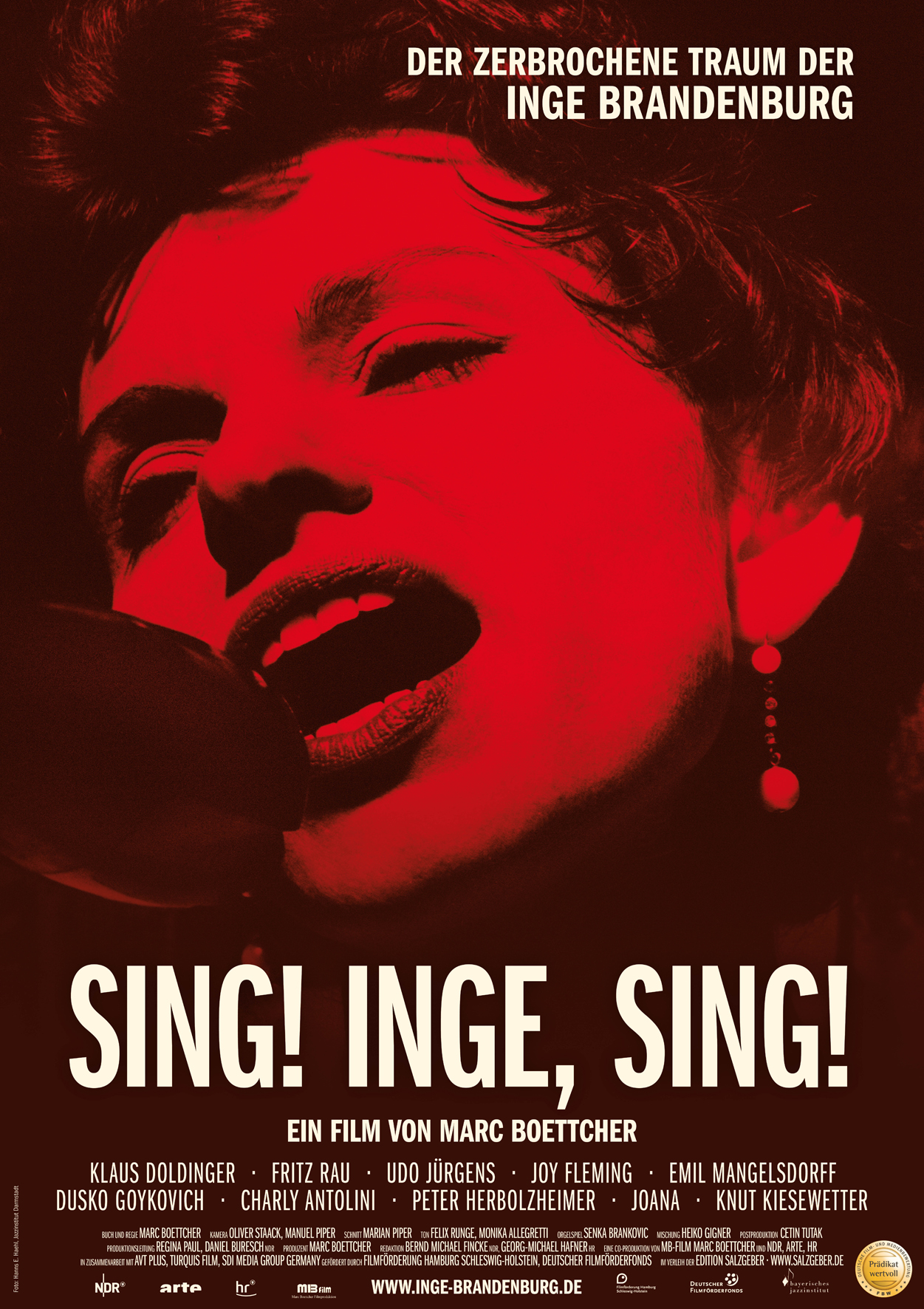
Sing! Inge, Sing!
THE BROKEN DREAM OF Inge Brandenburg
Jazz in Germany had a voice: Inge Brandenburg. Raised in difficult circumstances and used early on to standing on her own two feet, she was suddenly celebrated in the late 1950s as the best European jazz singer—compared by Time to Billie
Holiday, carried on the musicians’ hands—yet ignored by the German record industry and (unsuccessfully) reduced to schlager. It is the fate of a woman in the 1950s and 60s, a time when there was no place in Germany for self-confident
women with big dreams, a dramatic interpretive style, and an emancipated sensuality.
Years ago, the collector Thomas Rautenberg accidentally discovered an old photo album at a Munich flea market, filled with pictures of an attractive woman he did not recognize at all. It turned out to be Germany’s late number-one jazz singer: Inge Brandenburg (1929–1999).
Together with Marc Boettcher, he dove into a life full of deprivation, longing, and excess. In doing so, not only was a star unjustly forgotten rediscovered—at the same time, an important chapter of German cultural and contemporary history is told.
Trailer
Auszeichnungen & Nominierungen


Cinema version, 120 min: World premiere Filmfest Emden, 16 June 2011 – Cinema release: 25 Oct 2011
First broadcast on NDR television: 04 June 2013
First broadcast (ARTE version, 58 min): “The German Lady Jazz – Inge Brandenburg” on 05 Dec 2012
- Nominated for the Adolf Grimme Award 2013
- Award of the German Record Critics’ Prize
- “Best of” list 2012 (for both DVD and soundtrack)
- Documentary of the Month (March 2011)
- Rated “Valuable” by the Wiesbaden Film Rating Board (FBW)
Jury statement (04 March 2011): Inge Brandenburg was an exceptional artist, and this film sets a wonderful monument to her.
“(…) Along the way, using Inge Brandenburg as an example, the film also sketches a small cultural history of popular music in post-war Germany—where Germans’ lack of interest in good jazz and the constant temptations of schlager commercialism are the leitmotifs.
But it also tells the tragic story of an extremely complex and contradictory woman who stood up so uncompromisingly for her kind of music that she ultimately couldn’t help but fail commercially. And yet the film is not depressing, because again and again you see and hear Inge Brandenburg sing jazz—and she does so with such intense joy in performing that you can feel she must have been a happy person, at least in those moments when she had a microphone in front of her.”
Interview for the world premiere (16 June 2011)
Reviews

“Worth seeing.”

Impressive artist biography; a highly recommended portrait! Sing, Inge, Sing! is a worthy consolation for a great, missed opportunity in German post-war music history. An album with radio recordings extends the enjoyment of this unique voice.

A gripping portrait of a singer who wasn’t allowed to be what she wanted to be—and who broke under it.

…a wonderful monument.

A long-overdue rediscovery!

Moving portrait of the magnificent—yet always misunderstood—German jazz musician.

There’s much to praise in this vivid portrait. A valuable rediscovery.

A great documentary. Going to see it is well worth it!

You can tell in every minute that Marc Boettcher wanted to create an ambitious work against forgetting. Two hours that fly by and make you really want a CD by Inge Brandenburg with her multifaceted, dark voice. (Anne Daun, Dresdner Neueste Nachrichten, 27 Oct 2011)
A two-hour documentary painting.

Golden throat. With meticulous care, Boettcher traces the singer’s life and career using image and sound documents as well as interviews with former companions—and wisely gives her performances the most space (especially acoustically). Fascinatingly, they show that an interpreter of world-class stature has been completely forgotten. Worth seeing!

There are treasures that simply must be unearthed. Jazz singer Inge Brandenburg, with her extraordinary voice, is definitely one of them. This exciting contemporary document is complemented by interviews with German music and jazz greats—but the crown jewels are Inge Brandenburg’s appearances.

A strong, honest portrait that works very well… Watching the film inevitably triggers an angry disappointment in the audience. SING! INGE, SING! is a late reappraisal of the story of a central representative of West German female jazz, hidden under a thick layer of dust. Boettcher stirs up the dust and reassembles almost forgotten pieces, turning the film into a sensitive portrait and a piece of history at the same time. Perhaps the time is finally ripe for Inge Brandenburg.

The rediscovery of a woman who knew virtuoso ways to use her magnificent voice and developed surprising interpretations—in short: presumably the best jazz singer Germany has ever produced.

With the portrait and a CD, Boettcher was able to fulfill the jazz singer’s greatest wish posthumously—she never gave up the will to live out her talent.

Despite the many nicely prepared eyewitness snippets, Marc Boettcher’s award-winning film about Inge Brandenburg thankfully doesn’t come off as slick as a TV history lesson, but gives the portrayed woman the greatest space—above all acoustically. And that’s what makes it so exciting: as soon as Inge Brandenburg sings, it becomes magical.

A portrait that is as knowledgeable as it is empathetic, impressively demonstrating what was so fascinating about Inge Brandenburg and her singing style—and why she truly was one of the best jazz voices Germany has ever produced.

A painful gap finally closed… The little that Inge Brandenburg left behind belongs among the very best European vocal jazz has to offer. Marc Boettcher’s brilliantly researched, fascinating film about this extraordinarily interesting woman and breathtaking artist sets her a monument—broken, certainly, but one that also reminds us of the mistakes of her environment, which did not allow this artist to show what she had inside. A great loss for the jazz world. For research, editing, dramaturgy, cut, sound and image quality, and for its enchanting opening credits, the film (now available on DVD) deserves—as does the CD produced in parallel—our award: the ‘Muse’s Kiss.’