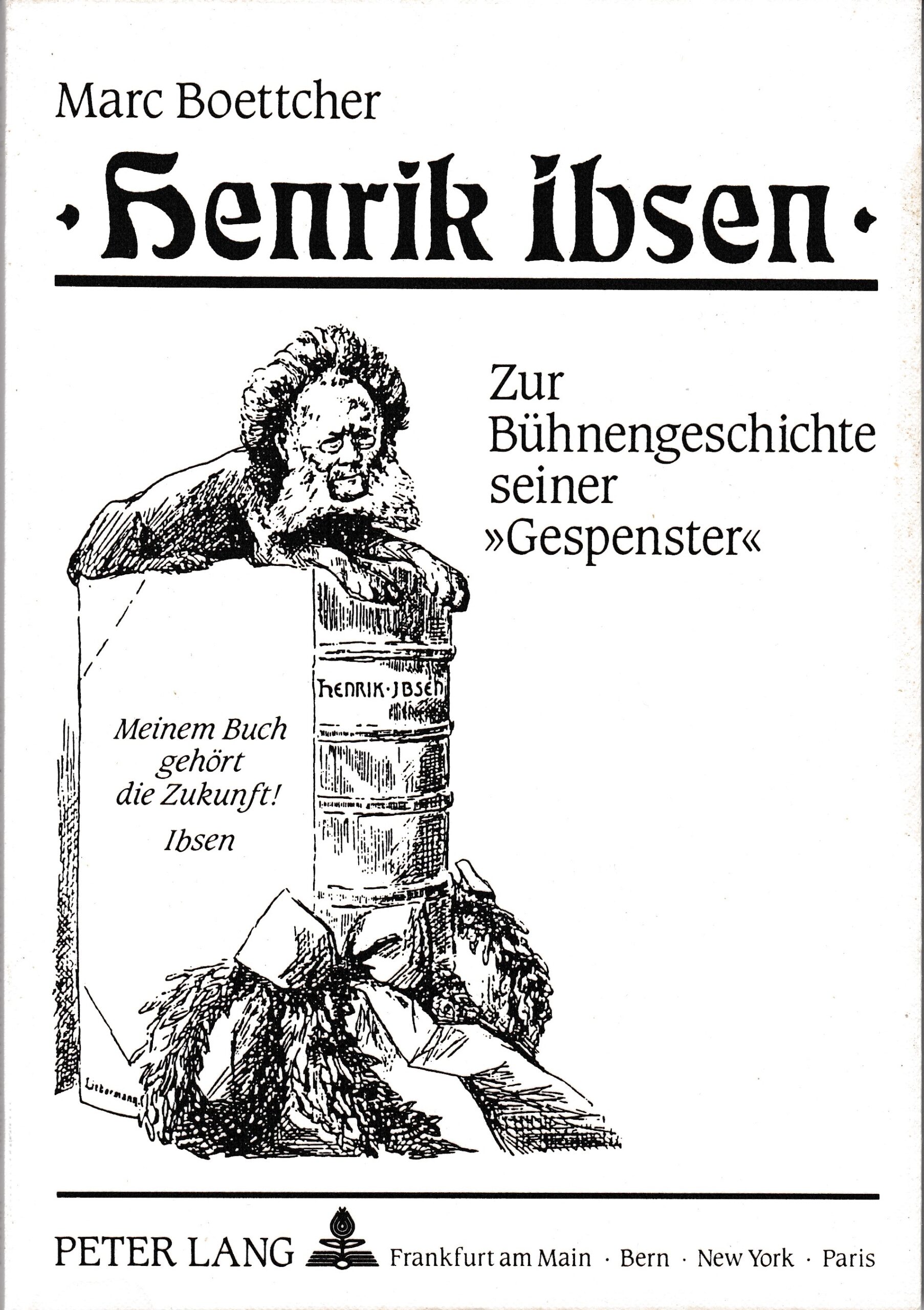
Henrik Ibsen
On the stage history of his “Ghosts”
Review by Tobias Burghardt, Delta – Journal of Essay Writing and Poetry, 1990:
“In light of changing realities, the play written by Ibsen in 1881 gains astonishing topicality: there is no play more apt about AIDS than ‘Ghosts’ (Einar Schleef). The socially critical approach of the piece—at the center of which
is, among other things, the medical history of a young man—can, from its concrete (Norwegian) setting, be transferred to universal connections that still shape our reality today.
The heart of the book is the excitingly readable and meticulous documentation of the stage history of this family drama—from its beginnings (for example, the world premiere on May 20, 1882, before Scandinavian immigrants in Chicago), through censorship bans, controversies and repeals, to the opening performance of the ‘Freie Bühne’ in Berlin in 1889; the opening of the ‘Berliner Kammerspiele’ in 1906 under the direction of Max Reinhardt (with a stage design by Edvard Munch); as well as a temporary decline of interest in Ibsen and his plays until the post-war era. A rediscovery of Ibsen—both on stage and in ‘philological research’—can be traced from Peter Stein’s seven-hour Peer Gynt production at Berlin’s ‘Schaubühne’ (1970/71).
Marc Boettcher’s dramaturgical work becomes indispensable for anyone who wants to examine the work and impact of ‘Ghosts’ in a nuanced and comprehensive way. The appendix contains censorship files, reviews, images, and other materials that meaningfully illustrate this remarkable insight into its stage history. Ibsen wrote to his publisher: ‘My book belongs to the future.’ Indeed.”